EUDR Compliance for Cattle & Leather: The Complete Plain-English Guide
Cattle is the only commodity in the EU Deforestation Regulation where a single animal can move through five or six different farms before it reaches a slaughterhouse - and the regulation requires you to geolocate every single one of them. That is what makes cattle and leather the most operationally demanding commodity in the EUDR, and why the supply chain from ranch to finished car seat or handbag is under more scrutiny right now than at any point in its history.
This guide is written specifically for beef exporters and importers, meatpackers, hide traders, tanneries, and leather goods and automotive buyers placing product on the EU market. It does not rehash the EUDR basics covered in our other commodity guides - it goes straight to what is different and harder about cattle.
What Is Currently in Scope: The Annex I Cattle Product List
Scope under the EUDR is determined entirely by whether your product's CN (Combined Nomenclature) code appears in Annex I of Regulation (EU) 2023/1115. If the code is not listed, the product is out of scope - even if it contains cattle-derived material.
The current Annex I cattle entries cover a wide range of products across the supply chain:
Live cattle; fresh or chilled meat; frozen meat; edible offal fresh or chilled; edible cattle livers frozen; frozen edible offal excluding tongues and livers; other prepared or preserved meat and meat offal of cattle; raw hides and skins; tanned or crust hides; and leather.
In the leather chain specifically, the three key codes under the current Annex I are:
- ex 4101 - Raw hides and skins of cattle (fresh, salted, dried, limed, pickled or otherwise preserved, but not tanned)
- ex 4104 - Tanned or crust hides and skins of cattle, without hair on, not further prepared
- ex 4107 - Leather of cattle, further prepared after tanning or crusting
The "ex" prefix matters: it means Annex I only captures the subset described in the right-hand column, not everything that can sit under that HS code. For cattle specifically, the "ex" clarifies that only cattle of the genus Bos and its subgenera are included - not buffalo (Syncerus) or bison (Bison).
What about tallow, gelatin, and collagen? These are cattle-derived products that appear in some industry discussions. The EUDR applies to cattle-derived products including beef and veal, leather, hides, live bovine animals, and other derived products such as gelatin, tallow, and collagen from cattle sources. However, the key test is always whether the specific CN code for those products appears in Annex I - check the official text and verify your product's classification before assuming it is in or out of scope.
Scope is determined by CN code, not by ingredient. A finished leather handbag or car seat is not itself listed in Annex I — but the leather component (ex 4107) is. The operator who first places the leather on the EU market carries the compliance obligation. Downstream manufacturers who receive leather with a valid DDS reference number have lighter obligations, but are not off the hook entirely.
The Leather Scope Question: What the Draft Delegated Act Actually Says
This is the most actively debated issue in the cattle/leather space right now, and it is important to be precise about what has and has not been decided.
The draft Delegated Act amending Annex I was published on 4 May 2026 as part of the Commission's EUDR simplification package. It is not yet binding - the Commission must formally adopt it, after which both the European Parliament and the Council have a scrutiny period of typically two months during which either can object.
The draft proposes two significant changes to the cattle section of Annex I:
Proposed removal: The Commission proposes to remove raw hides, tanned skins, and leather of cattle from the scope of the Regulation, arguing that EU operators have limited leverage over that supply chain. The Commission's rationale, as reported by legal analysts, is that companies often cannot get the information needed to meet EUDR rules because cattle hides are worth much less than meat and are traded differently.
Proposed addition: The Act also proposes expanding scope to include soluble coffee, certain palm oil derivatives, and frozen cattle tongues. On the tongue point specifically: fresh cattle tongues are already covered under existing Annex I entries for edible offal. However, frozen cattle tongues are not currently in scope. The draft inserts a new entry to bring frozen cattle tongues explicitly within scope, on the basis that excluding their frozen form creates an incoherent approach and may result in relocation rather than elimination of deforestation risk.
Environmental groups are pushing back hard. Arbitrarily removing leather from the EUDR would lead to significant policy incoherence: the meat from a cow raised on deforested land would be prohibited, while the skin of that same animal could be sold freely in the single market. The EIA, WWF, and other NGOs have formally urged the Commission to keep leather in Annex I.
The bottom line for planning purposes: Until the Delegated Act is formally adopted, the current Annex I as set out in Regulation (EU) 2023/1115 remains the binding list. Do not plan your compliance programme around the proposed removal of leather. Monitor the official Commission publications for the adoption date and the outcome of the parliamentary scrutiny period, and check the final adopted Annex I before making any scope decisions.
Why Cattle Is the Hardest Commodity for Traceability
Every other EUDR commodity - coffee, cocoa, soy, palm oil, rubber, timber - is produced on a fixed plot of land. You geolocate the farm, verify it against satellite imagery, and you are done. Cattle is fundamentally different.
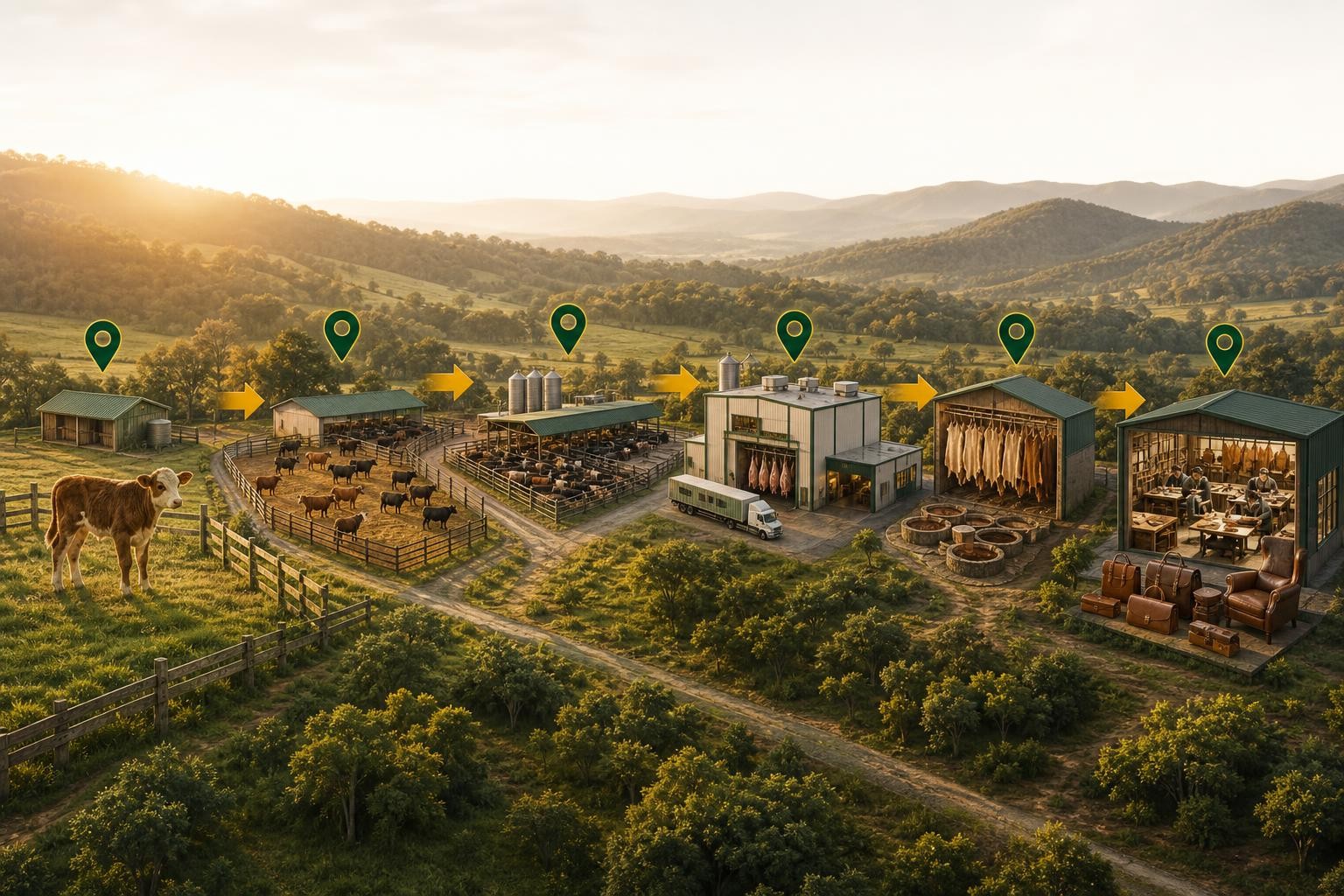
Operators who place cattle products on the market must geolocate all establishments associated with raising the cattle, encompassing the birthplace, farms where they were fed, grazing lands, and slaughterhouses. It is not enough to provide the geolocation of the land where the calf was born.
For all relevant commodities other than cattle, the date of production refers to the date of harvest, and the time range refers to the duration of the production process. For cattle, however, the time range takes into account the entire lifetime of the animal: from birth to slaughter.
This creates a data collection problem that has no equivalent in crop commodities. A single animal may have been born on one farm, moved to a backgrounding property, then to a feedlot, and finally to a slaughterhouse - each in a different location, potentially in a different region or even a different country. Every one of those establishments must be geolocated and included in the Due Diligence Statement.
For the leather chain, the problem compounds further. The hide leaves the slaughterhouse and enters a separate commercial stream - often traded through multiple intermediaries before reaching a tannery. Tanneries say the hide supply chain is difficult to trace, especially before slaughter, and that the burden falls unevenly on downstream operators who may have little control over ranches in an expansive network of agriculture operations. A tannery or leather goods manufacturer depends entirely on the upstream beef chain having collected and preserved that establishment data - data that was never previously required.
Geolocation Specifics for Cattle: What the Regulation Actually Requires
The good news for cattle operators is that the geolocation format is simpler than for crop commodities. Establishments where cattle are kept can be described with a single point of geolocation coordinate. You do not need to draw a polygon boundary around the entire farm - one latitude/longitude point per establishment is sufficient.
The coordinates must be expressed to at least six decimal places in decimal degrees (WGS84 format). For example: -15.123456, -47.654321. The formats currently supported by the Information System are GeoJSON file format and WGS-84, with EPSG-4326 projection.
Here is how the geolocation obligation flows through the supply chain:
For live cattle, operators must collect and submit all geolocation data up to the first placement on the EU market as part of the DDS. If the cattle are sold further along the supply chain, non-SME traders must add geolocations of any additional establishments where the animals were kept after the initial placement.
SME traders are not required to provide additional geolocation data points or issue new DDSs, but they still need to keep the collected information and the due diligence statement for at least five years.
One important note on timing: according to Article 1(2) of the Regulation, the EUDR does not apply to cattle and cattle-derived products if the cattle was born before the entry into force of the Regulation, i.e. before 29 June 2023.
| Aspect | Cattle | Crops (coffee, cocoa, soy, etc.) |
|---|---|---|
| Unit of traceability | Establishment (farm, feedlot, slaughterhouse) | Plot of land |
| Geolocation format | Single coordinate point per establishment | Single point (<4 ha) or polygon (≥4 ha) |
| Decimal places required | At least 6 | At least 6 |
| Number of locations required | All establishments from birth to slaughter | All plots that contributed to the batch |
| Time range of production | Entire lifetime of the animal | Harvest date / harvest period |
| Key challenge | Animal movement across multiple farms | Smallholder aggregation, plot mapping |
The Deforestation Cut-Off and Legality Dimension
The deforestation-free requirement means that none of the land on which the cattle were raised can have been converted from forest after 31 December 2020. This applies to every establishment in the animal's lifetime - not just the farm where it spent most of its life.
For a full explanation of how the cut-off date works and how to verify it against satellite data, see our dedicated cut-off date explainer. The short version: you need to cross-reference each establishment's coordinates against forest cover data from before and after 31 December 2020, using tools such as Global Forest Watch or the Commission's own monitoring resources.
The legality dimension is separate and equally important. Cattle must have been raised in compliance with the laws of the country of production - covering land use rights, environmental permits, and labour law. Geolocation information has to be positively verified to demonstrate that no deforestation took place after 31 December 2020.
Country Risk and Where Your Beef and Leather Come From
On 22 May 2025, the EU Commission published an initial list for country benchmarking, which classifies all countries in the world into three risk categories in order to map the risk of deforestation associated with beef, cocoa, coffee, palm oil, rubber, soy, and timber.
The three tiers determine how much due diligence work you must do:
- Low risk (~140 countries, including all EU member states): simplified due diligence - collect information and confirm negligible risk, but no full risk assessment required.
- Standard risk (~50 countries): full due diligence including risk assessment and mitigation under Articles 10 and 11.
- High risk (currently 4 countries): enhanced scrutiny, higher inspection rates by competent authorities.
As of May 2025, the European Commission has designated Belarus, Myanmar, North Korea, and Russia as high-risk countries. These countries are also under EU or UN sanctions.
For beef and leather specifically, the classification of major producing countries matters enormously. Countries that include major soy and beef producer Brazil are at standard risk under the current benchmarking. Countries well-known for tropical deforestation like Brazil, Indonesia, and the Democratic Republic of Congo have been classified as standard risk. Standard risk does not mean low risk in practice - it means full due diligence applies, including risk assessment and mitigation.
Brazil is classified as standard risk under the EUDR country benchmarking published on 22 May 2025, meaning full due diligence - including risk assessment and mitigation - applies to all beef and leather sourced from Brazil.
The risk classification defines the extent of compliance checks that Member States' competent authorities foresee among operators sourcing from different countries: 1% for low risk, 3% for standard risk, and 9% for high risk.
Critically, country ratings do not remove a company's legal responsibility. Whether sourcing from a country with a low, standard, or high risk, companies still need to make sure the products they import and sell are free from deforestation or illegality.
The benchmarking process will be dynamic, with a first review scheduled for 2026. Country classifications can change - a country currently at standard risk could move to high risk if deforestation data worsens. Build that possibility into your supplier contracts and risk management systems.
For the full country-by-country list and what each tier means for your due diligence workflow, see our country risk tiers guide.
Your Deadlines
Large and medium operators and traders must comply with the EUDR from 30 December 2026. Micro and small enterprises have until 30 June 2027, provided they were established as micro or small by 31 December 2024.
These dates are confirmed in law by Regulation (EU) 2025/2650 and will not move again. The Commission has explicitly signalled that the EUDR will not be reopened. Plan your compliance programme around these dates now.
Practical Steps: Mapping the Herd-to-Hide Chain
Here is what cattle and leather operators need to do before the deadlines hit.
Start with your CN codes. Cross-reference each product against the current Annex I of Regulation (EU) 2023/1115 — not the draft Delegated Act, which is not yet binding. Flag which products are in scope today and monitor the Commission's Official Journal for the final adopted Annex I once the delegated act process concludes.
If you are the first to place an in-scope cattle product on the EU market (an importer of beef, a tannery importing hides), you are an upstream operator and must submit a full Due Diligence Statement. If you receive product from an upstream operator who has already filed a DDS, you are a downstream operator with lighter obligations — but you still need to verify the DDS reference number and flag any concerns.
For every consignment of beef or hides, you need a single GPS coordinate (latitude and longitude to at least six decimal places, WGS84) for every establishment where the cattle were kept from birth to slaughter. This means birthplace farm, any backgrounding or fattening properties, feedlot, and slaughterhouse. Ask your abattoir or exporter for this data in writing. If they cannot provide it, the product cannot legally be placed on the EU market.
Cross-reference each establishment coordinate against forest cover data before and after 31 December 2020. Use tools such as Global Forest Watch or the Commission's monitoring resources. Document your verification method and the results — this is part of your risk assessment under Article 10.
Hides from multiple animals and multiple farms are typically pooled at the slaughterhouse and sold in mixed lots. The EUDR does not permit mass-balance approaches — commodities must be segregated from unknown-origin or non-compliant material at all stages. Work with your abattoir to understand whether they can provide lot-level traceability linking specific hides to specific animals and establishments. If not, this is a gap that needs to be resolved before December 2026.
In some countries, national livestock traceability systems are being adapted to support EUDR data flows. For example, Australia's Livestock Production Assurance (LPA) programme has introduced a geolocation sharing tool that allows cattle producers to provide establishment coordinates, which are then shared via the NLIS database through to feedlots, processors, and EU importers. Check whether equivalent schemes exist in your sourcing countries and whether they are EUDR-ready.
Compile all establishment geolocations, legality documentation, and your risk assessment into a DDS and submit it to the EUDR Information System before placing the product on the EU market or exporting it. The Commission is relaunching the Information System in summer 2026 ahead of the December deadline. Each DDS can reference up to 2,000 other DDSs and has a 25MB file size cap for geolocation uploads.
A Note on Soy Feed
If the cattle you are sourcing were fed on soy - itself an EUDR-regulated commodity - you may have an additional obligation. Operators must prove that the feed is deforestation-free if it is one of the relevant commodities or products under EUDR, such as soy bean flour. Ask your supplier whether the feed used was EUDR-compliant and document the answer.
Use Our Tools to Check Your Exposure
Not sure whether your specific products are in scope, or which country risk tier applies to your sourcing origins? EUDR Navigator's free tools let you check both without signing up.
What Leather Buyers in Automotive and Fashion Need to Know Right Now
If you are a car manufacturer, footwear brand, or luxury goods company buying finished leather goods or leather upholstery, your position depends on where in the chain you sit.
In 2022, the Environmental Investigation Agency's "Deforestation in the Driver's Seat" report traced leather used by the automotive industry to vast forest loss and to Indigenous lands in the Amazon. The regulatory and reputational risk is real regardless of how the Delegated Act resolves.
Under the current Annex I, if you are importing finished leather (ex 4107) into the EU for the first time, you are an upstream operator and must file a DDS. If you are buying from an EU-based tannery or leather goods manufacturer who has already placed the leather on the EU market, you are a downstream operator - you need their DDS reference number, not your own DDS.
Keeping leather under the rules could also create unfairness: EU producers of leather products would have to follow strict requirements, while importers of finished leather products like shoes and handbags could still sell them in the EU without complying with the same obligations. This asymmetry is part of the Commission's stated rationale for the proposed removal - but it is not yet law.
The practical advice: do not stand down your leather compliance programme based on the draft Delegated Act. Continue collecting establishment geolocation data from your supply chain. If leather is ultimately removed from Annex I, that data will still be valuable for CSRD, CSDDD, and Digital Product Passport obligations that are coming regardless.
For leather buyers in automotive and fashion: Even if the proposed Annex I amendment removes leather from EUDR scope, the Corporate Sustainability Due Diligence Directive (CSDDD) and the Digital Product Passport (DPP) will still require supply chain transparency on deforestation risk. The traceability infrastructure you build for EUDR is not wasted — it serves multiple incoming regulations.
Stay Current as the Delegated Act Moves Through Brussels
The leather scope question will be resolved - or not - in the coming months as the European Parliament and Council complete their scrutiny of the draft Delegated Act. This is the single most important regulatory development for the cattle and leather sector right now.
EUDR Navigator tracks every Commission publication, delegated act update, and FAQ revision so you do not have to. Subscribe to The EUDR Brief for a plain-English summary of every change that affects your business, delivered once a month with no sales pitch attached.
Key Facts at a Glance
- 30 December 2026 — compliance deadline for large and medium operators and traders
- 30 June 2027 — compliance deadline for micro and small enterprises
- 31 December 2020 — deforestation cut-off date: no land conversion from forest after this date
- 29 June 2023 — cattle born before this date are exempt from the EUDR
- 6 decimal places — minimum precision for geolocation coordinates
- 1 point per establishment — the geolocation format for cattle (not a polygon)
- All establishments from birth to slaughter — the scope of geolocation required
- 4 May 2026 — date the draft Delegated Act was published (not yet binding)
- Standard risk — the current benchmarking classification for Brazil and most major beef/leather producing countries
Related reading
EUDR Compliance Costs After Simplification: What the 75% Figure Actually Means for Your Budget
The Commission estimates a 75% cut in EUDR compliance costs EU-wide. Here's why that aggregate figure doesn't map onto your invoice - and how to build a budget you can actually defend.
EUDR Risk Assessment and Mitigation: How to Show 'No Risk or Only Negligible Risk' (Articles 10 and 11)
Between collecting supplier data and filing a due diligence statement sits the step most teams under-document: risk assessment and mitigation. Here is how the two stages work and how to evidence them.
Indonesia, Palm Oil and the EUDR: Why Processed Imports Are the Real Exposure
Indonesia supplies a modest share of the EU's crude palm oil but more than half of its processed palm oil. That split, plus a forecast production dip in 2027, shapes where EUDR exposure sits.