EUDR Coffee Compliance: The Complete Guide for Importers and Roasters
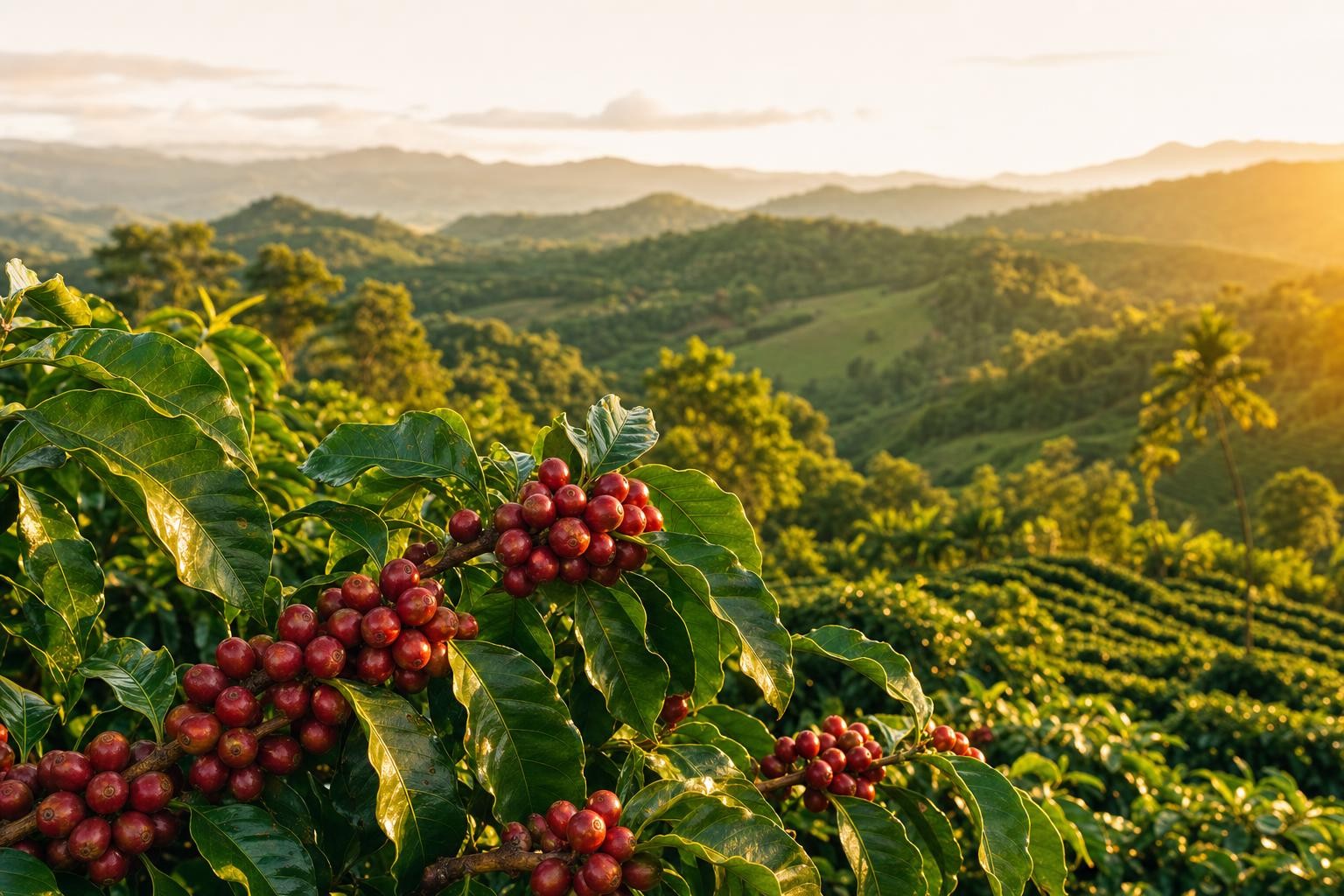
Coffee is one of the most widely traded commodities on earth - and one of the seven commodities at the heart of the EU Deforestation Regulation. If you import green beans, sell roasted coffee, or trade any coffee-derived product into the EU market, the EUDR applies to you. The deadline is confirmed, the IT system is live, and the first shipments are already being scrutinised at the border.
This guide covers what the regulation actually requires for coffee, where the hard problems are, and what a practical compliance programme looks like - without the fluff.
What Coffee Products Are in Scope
The EUDR covers seven commodities: cattle, cocoa, coffee, palm oil, rubber, soya, and wood. For coffee specifically, scope is determined by CN/HS code, not by the word "coffee" on a label.
For coffee, the EUDR covers products with HS code 0901: coffee, whether or not roasted or decaffeinated; coffee husks and skins; coffee substitutes containing coffee in any proportion.
That means the following are all in scope:
- Green (unroasted) coffee beans - the primary import form
- Roasted coffee beans - whole or ground
- Decaffeinated coffee - in any form
- Coffee husks and skins - including cascara
- Coffee substitutes containing coffee in any proportion
Scope is confirmed by matching your product's CN code against Annex I of Regulation (EU) 2023/1115 - not by ingredient labelling or trade name.
If a product is not listed in Annex I, it is out of scope, even if it contains a relevant commodity. So a coffee-flavoured confectionery that carries a different CN code may fall outside the regulation's reach - but you need to verify your specific code, not assume. Our EUDR Annex I scope changes post covers the May 2026 delegated act that clarified several borderline CN code entries.
Who Is the "Operator" for Coffee?
The EUDR places the heaviest obligations on operators - defined as any person who, in the course of a commercial activity, first places a relevant product on the EU market or exports it from the EU.
An operator is any "natural or legal person who, in the course of a commercial activity, places relevant products on the market or exports them." Placing on the market means the first time that the product is made available in the EU.
In a typical coffee supply chain, that is usually the EU-based importer who clears green beans through customs and makes them available for sale. If you are a roaster buying from an EU importer who has already filed a Due Diligence Statement (DDS), you are a downstream operator or trader with lighter obligations - but you still need to reference the DDS and maintain traceability records.
If you are the first entity to place coffee on the EU market — even if you immediately sell it on to a roaster — you are the operator and you carry the full due diligence obligation. You cannot pass that legal responsibility upstream to your exporter or downstream to your customer.
The Three Core Obligations
Every operator placing coffee on the EU market must satisfy three requirements before a single shipment moves.
1. Information Collection
You must gather and document:
- The quantity and description of the product (HS code, net mass)
- The country of production and, where applicable, sub-national area
- Geolocation coordinates of every plot of land where the coffee was grown
- The name and contact details of every supplier in your chain
- Evidence that the coffee was legally produced under the laws of the country of origin (land-use rights, environmental permits, labour law compliance, tax obligations, anti-corruption rules)
The geolocation requirement is the most operationally demanding. For plots of land of more than four hectares, geolocation has to be provided using polygons - meaning latitude and longitude points of six decimal digits to describe the perimeter. For plots of land under 4 hectares, operators may instead describe geolocation with one latitude and longitude point only.
Plots under 4 hectares require a single GPS coordinate point; plots of 4 hectares or more require a full polygon boundary submitted in GeoJSON format using the WGS84 projection system.
All geolocation data must be submitted in GeoJSON format, using the WGS84 (EPSG:4326) projection system. This ensures compatibility with the EU's TRACES Information System and enables satellite-based verification.
2. Risk Assessment
Once you have the information, you must conduct a documented deforestation risk assessment for each lot. The assessment must consider:
- Whether the land was deforested or forest-degraded after 31 December 2020 - the regulation's fixed cut-off date
- The country and sub-national risk classification under the EU's benchmarking system
- Complexity of the supply chain (number of intermediaries, aggregation points)
- Prevalence of deforestation in the region
- Reliability and verifiability of the information provided
When the Commission released its benchmarking list in May 2025, every major African coffee origin - including Ethiopia, Uganda, Kenya, Rwanda, Tanzania, Burundi, Cameroon, and the DRC - was placed in the standard-risk category, meaning smallholders see no meaningful relief from the core requirements: plot-level geolocation, due diligence statements, and proof that the land was not deforested or degraded after December 31, 2020.
In practice for the coffee industry, this means Brazil, Vietnam, Colombia, Ethiopia, Honduras, Guatemala, and other major producers are subject to full due diligence - regardless of actual deforestation rates in specific production regions. Our country risk tiers guide explains how the benchmarking system works and what low, standard, and high risk mean for your due diligence burden.
The risk assessment must reach a negligible-risk conclusion before you can proceed. If it cannot, you must either implement risk-mitigation measures or decline to place the lot on the market.
3. Due Diligence Statement (DDS) in TRACES
Companies subject to the regulation are required to submit a Due Diligence Statement (DDS) before placing relevant products on the EU market or exporting them. The European Commission has integrated the DDS submission process into TRACES-NT, its official platform. Using TRACES-NT is mandatory for all operators and traders who need to comply with the EUDR.
The DDS is your formal declaration that due diligence has been exercised, that the coffee is deforestation-free, legally produced, and that the information provided is accurate. Customs authorities check the DDS reference number at the border. No DDS, no clearance. Our step-by-step TRACES filing guide walks through the registration and submission process in detail.
The Hardest Part: Tracing Coffee to the Plot
Of all the EUDR commodities, coffee presents some of the most acute traceability challenges. The reason is structural.
Roughly 12.5 million smallholder coffee farmers produce most of the world's coffee, with many working plots under 2 hectares in regions with patchy internet and no formal land registry.
Roughly 12.5 million smallholder coffee farmers produce most of the world's coffee. Many of them work plots under 2 hectares, in regions with patchy internet and no land registry. Asking them to provide geolocation data on their own is, for now, unrealistic. The burden falls on cooperatives, importers, and government extension programs to do the mapping for them.
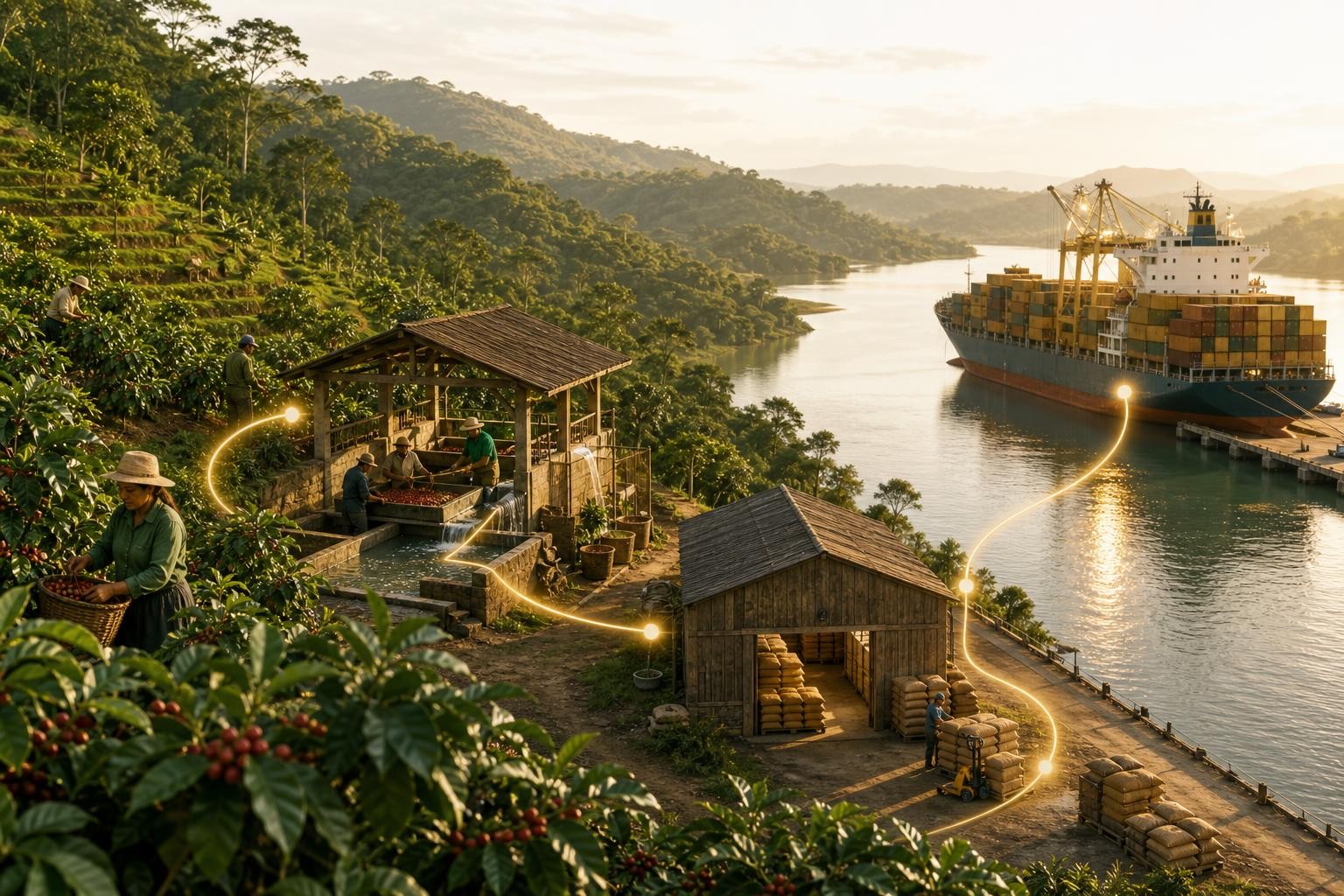
The supply chain structure compounds the problem. Traditional coffee supply chains are characterised by multiple intermediaries: farmers sell to local collectors, who aggregate supplies for cooperatives or exporters, who then sell to international traders and roasters. This layered structure often means that roasters and importers have limited visibility beyond their direct suppliers. The EUDR fundamentally disrupts this model by requiring end-to-end traceability to the farm level.
Around 50% of coffee imported into the EU is "disenfranchised" - it passes through many intermediaries between the farm and the exporter. For example, up to 10 different small intermediaries will participate in a coffee's journey from a plot of land to the exporter in countries like Vietnam or Indonesia. Similarly, national auction systems in Eastern Africa (Kenya, Ethiopia, Tanzania) are also a challenge to ensuring strict traceability.
Aggregation at washing stations and cooperatives is the single biggest compliance blind spot. When lots from dozens of smallholders are pooled before processing, the link between individual plots and the final shipment is broken. Roasters often mix beans from different farms or cooperatives. If one farm in that blend is non-compliant, the whole lot is in trouble.
What Certification Schemes Can and Cannot Do
Many coffee importers already work with Rainforest Alliance, UTZ, or other sustainability certification schemes. These are valuable - but they do not satisfy EUDR on their own.
The Rainforest Alliance does not issue due diligence statements or upload anything to the EU platform on behalf of companies. The Rainforest Alliance provides the platform and access to key data for market partners to fulfil their obligations under the EUDR - but it does not issue due diligence statements or upload anything to the EU platform on behalf of companies.
While certifications like FSC, RSPO, or Rainforest Alliance provide valuable assurance, they don't automatically satisfy EUDR requirements. Certified suppliers still require geolocation data, and certification schemes may not cover all EUDR criteria. Treat certifications as supporting evidence, not substitutes for company-led due diligence.
When you submit the DDS, you are legally accountable - not the certification body. Use certifications as a risk reduction input in your assessment framework. Still collect actual plot-level coordinates and confirm no post-2020 deforestation independently.
The practical implication: Rainforest Alliance certification can help you lower a supplier's risk score in your assessment and may reduce the depth of additional verification needed - but you still need the geolocation data, and you still need to file the DDS yourself.
Deadlines: What Is Confirmed
After two rounds of delays, the European Commission has drawn a firm line.
The European Commission confirmed in May 2026 that there will be no further postponement of the EUDR application date.
The Commission's report confirms there will be no further delays in implementation. Compliance deadlines remain 30 December 2026 for large and medium operators, and 30 June 2027 for most micro and small operators.
Compliance costs are expected to be reduced by approximately 75% compared to the original EUDR framework, though core due diligence obligations remain fully in place.
The May 2026 simplification package introduced updated guidance and a draft delegated act on product scope, but it did not reopen the regulation text. The obligations described in this guide - geolocation, risk assessment, DDS - remain unchanged. Our 2026 simplification package explainer covers what did and did not change.
| Operator Category | Compliance Deadline | Key Obligations |
|---|---|---|
| Large & medium operators | 30 December 2026 | Full DDS, geolocation, risk assessment, 5-year record keeping |
| Micro & small operators (most) | 30 June 2027 | Full DDS, geolocation, risk assessment, 5-year record keeping |
| Downstream operators / traders | Same as above by role | Reference DDS number, maintain traceability records, register in EU Information System |
The Practical Playbook: Six Steps for Coffee Importers
Here is a structured approach to building a defensible compliance programme for coffee.
Identify every supplier, exporter, cooperative, and washing station in your chain for each origin. You need to know who you are buying from, who they are buying from, and at what point lots are aggregated. This is the foundation — without it, you cannot collect the right data.
Check the EU country benchmarking for each origin country. As of mid-2026, all major coffee origins — Brazil, Vietnam, Colombia, Ethiopia, Honduras, Guatemala, Uganda, and others — sit in the standard-risk category, meaning full due diligence applies. No origin currently qualifies for the simplified low-risk pathway.
Request GPS coordinates for every farm plot in your supply chain. For plots under 4 hectares (the majority of smallholder farms), a single latitude/longitude point suffices. For plots of 4 hectares or more, you need a full polygon boundary. Work with your exporters and cooperatives to collect this data before harvest — not after shipment.
Cross-reference the plot coordinates against satellite-based forest monitoring data to confirm no deforestation occurred after 31 December 2020. Several free and commercial tools can do this. Document the verification methodology and results — this is the evidence base for your risk assessment.
Assess each lot against the full set of risk factors: country tier, supply chain complexity, legality evidence, and deforestation verification results. Reach a written negligible-risk conclusion — or document why you cannot and what mitigation steps you are taking. This document is what a competent authority will ask to see.
File your Due Diligence Statement in TRACES NT before the shipment is placed on the market. Retain all supporting documentation — geolocation files, supplier declarations, legality evidence, risk assessments — for a minimum of five years. Competent authorities can request this at any time.
The Consequences of Getting It Wrong
Non-compliance is not a paperwork issue - it is a market-access issue.
Penalties include fines up to 4% of EU turnover, confiscation of goods and profits, market bans, product recalls, and suspension of simplified procedures. Multiple penalties can apply together.
Operators may be barred from selling regulated commodities or from participating in public tenders for up to 12 months.
Authorities are also required to report enforcement outcomes to the European Commission, which will publish company names, violations, and penalties - making reputational risk part of the consequence.
Under Article 25 of Regulation (EU) 2023/1115, fines for non-compliance are set at a minimum of 4% of the company's annual EU turnover.
You are required to maintain all documentation related to EUDR compliance for five years. That includes geolocation files, supplier declarations, legality evidence, and the risk assessment itself - not just the DDS reference number.
Where to Start Today
The December 2026 deadline is six months away for large and medium operators. That is not a long runway when you consider the time needed to map supply chains, engage exporters, collect geolocation data, and build a repeatable risk assessment process.
The most common mistake is waiting for perfect data before starting. A documented, good-faith due diligence process showing evidence of data collection attempts, gap analysis, and corrective action plans is far stronger in a competent authority audit than no documentation. Start building your data infrastructure now, even imperfectly.
Use our free EUDR Obligations Checker to confirm your exact obligations based on your company size, role, and sourcing origins. If you are still unsure whether your specific coffee products are in scope, the EUDR Scope Assessment will walk you through the CN code check in minutes.
Key Takeaways
- Coffee is fully in scope under Annex I (HS 0901) - green, roasted, decaffeinated, husks, and coffee-containing substitutes all qualify.
- The importer who first places coffee on the EU market is the operator and carries the full due diligence obligation.
- Geolocation to the plot is non-negotiable: a single GPS point for plots under 4 hectares; a polygon for plots of 4 hectares or more.
- Certification schemes support but do not replace the DDS - you remain legally responsible when you sign.
- 30 December 2026 is confirmed for large and medium operators; 30 June 2027 for most micro and small operators. No further delays are expected.
- Records must be kept for five years and made available to competent authorities on request.
The regulation is complex, but the core ask is straightforward: know where your coffee comes from, prove it was not grown on deforested land, and document everything. Start that process now.
Related reading
Keep Smallholders In or Cut Them Out? The EU Buyer's EUDR Decision
EU buyers face a real choice: de-risk by dropping smallholders, or invest to keep them in. This guide makes the business and compliance case for inclusion - and shows how to make it work.
Automating EUDR DDS Filing: A Realistic Integration Guide for the 30 December 2026 Deadline
The EUDR Information System API specs are now final. With 16 weeks to 30 December 2026, here's how to decide whether to automate DDS filing - and how to do it in time.
EUDR Enforcement in 2026: How Competent Authorities Will Monitor, Flag, and Penalize Non-Compliance
Article 25 gives every EU Member State the same four sanctions to work with - fines, confiscation, procurement exclusion, and trading bans - but each Competent Authority enforces them nationally. Here's how the monitoring and penalty system actually works as enforcement obligations begin.