EUDR Country Risk Tiers Explained: Low, Standard, and High Risk in Plain English
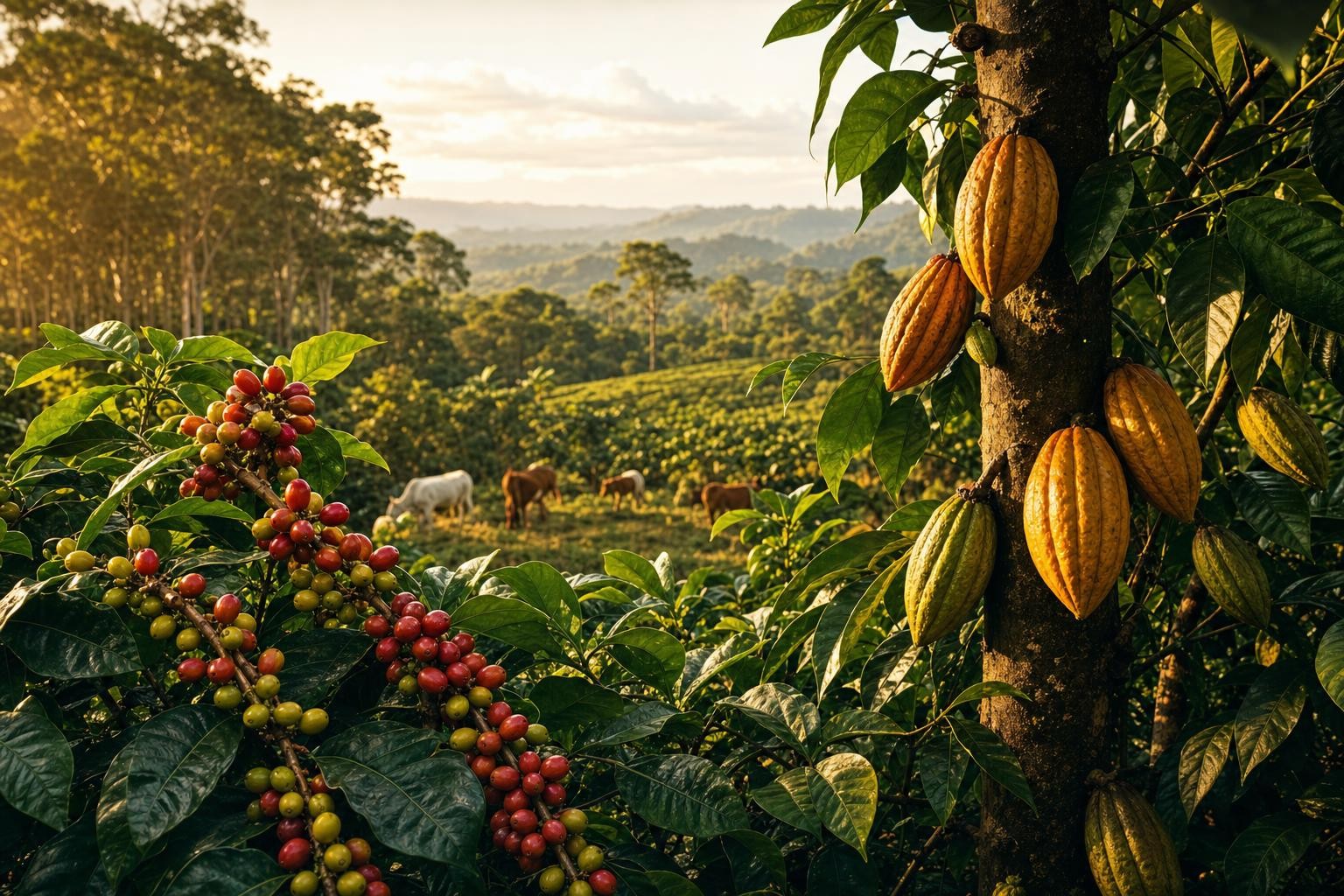
Here is the answer up front: the EUDR country risk tier for a country has almost nothing to do with how much of a commodity it produces. Some of the world's biggest coffee, rubber, and cocoa producers sit in the low-risk tier. Meanwhile, the four countries that are actually high risk are there because of sanctions, not because of deforestation rates. If you have been guessing a country's tier from its production volume, you have probably been getting it wrong.
Where the tiers come from
The three-tier classification - low, standard, and high risk - was established by Implementing Regulation (EU) 2025/1093, published by the European Commission on 22 May 2025. The regulation sets out which countries present a low or high risk of producing EUDR-relevant commodities that are not deforestation-free. [1] classifies countries according to the level of risk of producing commodities covered by the EUDR that are not deforestation-free, and the classification was adopted through an implementing act.
Standard risk is the default. Countries not classified as low or high risk fall into the standard risk category. That means you do not need to find a country on a "standard risk list" - if it is not explicitly listed as low or high, it is standard.
The three tiers at a glance
| Tier | Who is in it | Due diligence required | Authority check rate |
|---|---|---|---|
| Low risk | ~140 countries, including all EU states, UK, US, Canada, China, Japan, Australia, India, Vietnam, Thailand, Ghana, Chile, Uruguay | Simplified: collect information and confirm negligible risk, but no full risk assessment or mitigation steps | At least 1% of operators checked per year |
| Standard risk | ~50 countries, including Brazil, Indonesia, Malaysia, Côte d'Ivoire, Cameroon, Nigeria, Ecuador, Colombia, Peru, Argentina, Paraguay | Full due diligence: collect information, assess risk, mitigate non-negligible risk, submit a due diligence statement | At least 3% of operators checked per year |
| High risk | 4 countries only: Belarus, Myanmar, North Korea, Russia | Full due diligence plus enhanced scrutiny from authorities | At least 9% of operators and 9% of product volume checked per year |
The counter-intuitive part: who is actually low risk
This is where most people are surprised. Around 140 countries are classified as low risk under Implementing Regulation (EU) 2025/1093, including all EU member states, the UK, the US, Canada, China, Japan, Australia, India, Vietnam, Thailand, Ghana, Chile, and Uruguay. The 140 low-risk countries include all EU Member States, the UK, the US, Canada, China, Japan, Australia, and South Africa.
Several of those names will raise eyebrows among supply chain teams. India is a significant producer of coffee and rubber. Vietnam is one of the world's largest coffee exporters. Ghana is a major cocoa producer. Yet all of them sit in the low-risk tier, which means operators sourcing from those countries can use simplified due diligence rather than the full process.
Why? All countries were assessed on the basis of the quantitative criteria set out in Article 29(3) of the Deforestation Regulation, using the latest available data from the Global Forest Resources Assessment dataset by the Food and Agriculture Organization of the United Nations (FAO FRA). The methodology weighs deforestation and forest degradation rates, governance quality, and other factors - not production volume.
Low-risk status does not mean zero obligations. You still need to collect information from suppliers — including geolocation of plots — and confirm there is no indication of sourcing from standard- or high-risk countries. You skip the full risk assessment and mitigation steps, but you do not skip due diligence entirely.
Standard risk: the tier that covers most major producers
Standard risk includes approximately 50 countries, among them Brazil, Indonesia, Malaysia, Côte d'Ivoire, Cameroon, Nigeria, Ecuador, Colombia, Peru, Argentina, and Paraguay. Around 50 countries are classified as standard risk, including key commodity producers such as Brazil, Indonesia, and Malaysia. Operators sourcing from standard-risk countries are subject to full due diligence obligations and must also submit a due diligence statement.
Full due diligence means collecting information, carrying out a risk assessment, and mitigating any non-negligible risk before you can place the product on the EU market. Those sourcing from standard- or high-risk countries must meet the full scope of EUDR obligations, including assessing risks for legal production, deforestation, and forest degradation, as well as mitigating non-negligible risks.
One thing worth noting: a standard-risk label does not mean the Commission thinks deforestation is not happening there. A "standard risk" label does not mean low deforestation risk; it simply means the EU expects companies to take responsibility for verification themselves.
High risk: only four countries, and the reason may surprise you
Only four countries are classified as high risk under Implementing Regulation (EU) 2025/1093: Belarus, Myanmar, North Korea, and Russia. Just four countries received high-risk designation: Belarus, Myanmar, North Korea, and Russia. Countries under UN Security Council or EU Council sanctions for EUDR-relevant commodities automatically fall into the high-risk category.
The reason these four are high risk is primarily about sanctions and the impossibility of credible verification, not about deforestation rates per se. A "high risk" classification means the European Commission considers it difficult or impossible to verify whether commodities from that country are deforestation-free and legally produced.
For operators who do source from high-risk countries, the scrutiny is significantly heavier. Annual checks by national competent authorities must cover at least 1% of relevant operators for low-risk countries, at least 3% for standard-risk countries, and at least 9% of relevant operators and 9% of relevant product volume for high-risk countries.
What each tier means for your day-to-day compliance
The tier of your sourcing country directly shapes two things: how much due diligence work you must do, and how likely you are to be checked by authorities.
Low risk: Companies sourcing products from low-risk countries may conduct a "simplified" due diligence process. While they will still be required to collect information from their suppliers (including geolocation of plots and adequately conclusive and verifiable evidence of compliance with EUDR legality and deforestation criteria), they will not be obligated to carry out the risk assessment and mitigation steps outlined in Articles 10 and 11 of the Regulation.
Standard risk: Full due diligence applies. You collect information, assess risk, and mitigate before placing goods on the market. The inspection rate for standard-risk operations is 3%.
High risk: Full due diligence applies, plus enhanced scrutiny. For high-risk countries, the inspection rate by competent authorities rises to 9%, compared to only 1% for low-risk and 3% for standard-risk regions. That means almost one in ten shipments could be checked for compliance.
Not sure which obligations apply to your specific role and product? Use the Obligations Checker to get a tailored answer.
Answer a few quick questions about your role and product to see exactly which due diligence steps apply to you.
The most important warning: tiers can and will change
Do not assume a country's tier is permanent, and do not infer it from production data or news coverage. Always check the official source.
The benchmarking process is dynamic, with a first review scheduled for 2026. This review is intended to take account of updated FAO FRA data, expected to be published in October 2025.
There is also political pressure on the current list. On 9 July 2025, the European Parliament adopted a resolution (2025/2739(RSP)) on the implementing regulation. Based on the parliamentary right of scrutiny, the Parliament called on the Commission to repeal the implementing regulation and revise the country benchmarking system. However, this resolution is not legally binding. The Commission's Implementing Regulation (EU) 2025/1093 is not blocked or annulled, and the Commission is under no obligation to withdraw it. The country benchmark classifications remain in force.
The practical upshot: companies must continue to use the three-tier country classification as the basis for their risk assessment and the implementation of due diligence obligations, while closely monitoring possible tightening of the rules and any reclassifications.
What to do next
Two steps will take you from reading to ready:
Look up your sourcing countries. The EUDR Country Risk List on this site lets you search any country and see its current tier, what it means for due diligence, and the authority check rate - all in plain English.
Understand your specific obligations. The tier is only one input. Your role (operator, trader, or downstream operator) and the size of your business also shape what you must do. The EUDR Obligations Checker walks you through both in a few questions.
The list is under active review. Bookmark both tools and check back after the 2026 benchmarking update - a reclassification of even one key sourcing country could change your compliance workload significantly.
This post is for information only and is not legal advice. Always verify country tiers against the official [1] before relying on them for compliance decisions.
Scoring every supplier against these tiers by hand is the grind. Spureon benchmarks all of your suppliers against the EU list automatically and keeps each assessment current as the tiers change. See doing EUDR by hand vs. automated.
Related reading
Keep Smallholders In or Cut Them Out? The EU Buyer's EUDR Decision
EU buyers face a real choice: de-risk by dropping smallholders, or invest to keep them in. This guide makes the business and compliance case for inclusion - and shows how to make it work.
Automating EUDR DDS Filing: A Realistic Integration Guide for the 30 December 2026 Deadline
The EUDR Information System API specs are now final. With 16 weeks to 30 December 2026, here's how to decide whether to automate DDS filing - and how to do it in time.
EUDR Enforcement in 2026: How Competent Authorities Will Monitor, Flag, and Penalize Non-Compliance
Article 25 gives every EU Member State the same four sanctions to work with - fines, confiscation, procurement exclusion, and trading bans - but each Competent Authority enforces them nationally. Here's how the monitoring and penalty system actually works as enforcement obligations begin.