EUDR and Soy: The Practical Compliance Guide for Importers, Crushers, and Feed Producers
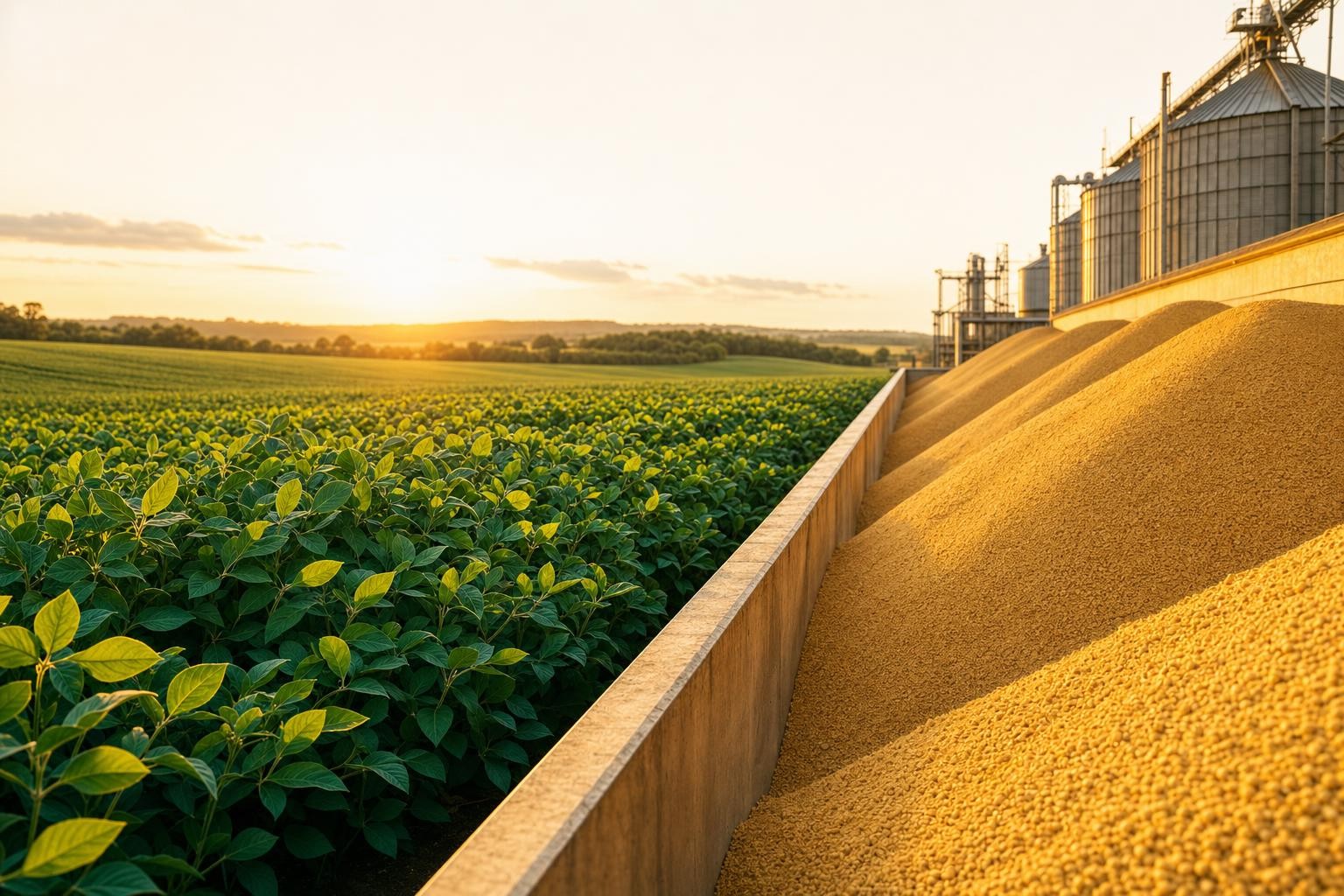
Soy is the commodity that keeps compliance teams up at night - and for good reason. Unlike coffee or cocoa, where the challenge is mainly reaching smallholder farmers, soy has an additional structural problem: it is deliberately blended. Grain from dozens or hundreds of farms is tipped into shared silos, hauled by multiple truckers, crushed together, and stored in bulk at export terminals. By the time a vessel loads soy meal for Rotterdam, the original farm-level data has usually vanished. The EUDR does not care. It requires plot-level geolocation for every farm that could have contributed to a shipment - and there are no exemptions for blended products.
This guide is for EU operators (importers), crushers and processors, and animal-feed producers who place soy or soy-derived products on the EU market. It focuses on what makes soy uniquely difficult and what you need to do about it before the clock runs out.
What Soy Products Are In Scope - and What Isn't
In scope
Soy is one of the seven core EUDR commodities. The regulation covers soybeans and a defined list of derived products identified by their CN/HS codes in Annex I. The most commercially significant in-scope products for the feed and processing sectors are:
| Product | Typical HS code |
|---|---|
| Soybeans (whole) | 1201 |
| Soybean oil (crude & refined) | 1507 |
| Soy meal / oilcake | 2304 |
| Soy flour and pellets | 1208 |
The regulation requires every soy product to be traceable back to the farm plot level. If your CN code appears in Annex I, you are in scope - regardless of whether the soy is destined for human food, animal feed, or industrial use. Use our scope checker if you are unsure whether a specific product code is covered.
Out of scope - but read carefully
Several soy-adjacent products are not in scope, and the distinction matters:
- Compound feed as a finished product is not listed in Annex I, so placing compound feed on the EU market does not itself trigger EUDR obligations. However, if you also trade soybean meal or soy oil as standalone products, those trades are in scope.
- Products made from soy-fed animals - poultry meat, pork, eggs, farmed fish - are excluded. The EUDR does not follow the soy into the animal.
- Tofu, soy sauce, and plant-based meat alternatives are typically classified under CN codes not listed in Annex I and are therefore out of scope.
Feed manufacturers who also trade soy products commercially are in scope as operators for those trading activities, even if their compound feed output is not. Check your role carefully — our obligations checker can help.
The Geolocation and Blending Problem - Soy's Defining Challenge
This is where soy diverges sharply from other EUDR commodities. Soy rarely stays in neat, separate piles. Grain from scores of farms is tipped into shared silos, hauled by many truckers, blended in crushing plants, and stored together at ports. Once blended, the original source data usually disappears.
The European Commission's FAQ confirms that mass balance supply chains do not fulfil EUDR requirements - commodities must be segregated from unknown-origin or non-compliant material at all stages.
In plain terms: if your soy meal mixes multiple origins and you cannot provide geolocation for all plots that could have contributed to the final product, the entire batch is non-compliant. Mixing compliant material with anything of unknown or unverifiable origin automatically makes the whole batch non-compliant.
Why this is harder for soy than for coffee or cocoa
- Scale of aggregation. Soy supply chains flow through smallholder farms -> aggregators -> crushers -> meal/oil processors, with batches blended at storage and losing farm-level origin at each step.
- Storability. Unlike coffee or cocoa, soy can be held in storage for extended periods depending on market conditions, which allows traders to hold stock across seasons and further obscures origin.
- Competition discourages data-sharing. Competition between actors in the supply chain - particularly in Brazil and Argentina - can discourage information-sharing, making it harder to obtain plot-level data from upstream suppliers.
- Data quality gaps. Accurately mapping farms and defining exact geolocation remains a challenge in remote regions where digital infrastructure is limited. Errors in farm mapping - incorrect coordinates or overlapping boundaries - can result in the rejection of due diligence statements.
What operators must do about blending
You have three practical options, and none of them is easy:
- Segregated supply chains. Source from crushers or traders who maintain physical segregation from farm to port - separate silos, separate crushing lines, batch coding, and a first-in-first-out approach at storage facilities. This is the cleanest solution but requires upstream investment.
- Full-origin disclosure for blended lots. If you cannot segregate, you must collect geolocation for every farm that could have contributed to the blended lot. This means working back through the aggregation chain to identify all contributing plots.
- Stop sourcing from unverifiable origins. If a supplier cannot provide plot-level coordinates for their contribution to a shipment, that material cannot be used in an EU-bound lot.
Due Diligence and the DDS: Step by Step
The EUDR's due diligence obligation has three legally required steps, followed by a mandatory filing. Here is what each means for a soy importer in practice.
Gather everything the regulation requires before you can assess risk. For soy, the critical data points are: - Plot-level geolocation: latitude/longitude coordinates for small plots, or polygon boundaries for larger farms. Silo or trading-house coordinates are not valid — the regulation requires the production plot. - Country and region of production (e.g. Mato Grosso, Brazil) - Supplier chain: farm → cooperative/aggregator → crusher/trader → EU importer - Quantity and HS code of the product - Evidence of legality: compliance with source-country laws, including land tenure, labour rights, and environmental permits - Cut-off date confirmation: evidence that the land was not converted from forest to agricultural use after 31 December 2020
Use the information collected to assess whether there is more than negligible risk that the product is not deforestation-free or not legally produced. For standard-risk countries like Brazil and Argentina, this is a full assessment — you cannot skip it. Factors include: country and region risk classification, proximity to deforested areas, satellite verification of land-use change, and the reliability of your supplier's data. Remote sensing tools and GIS-based forest cover maps are required verification methods.
If your assessment identifies non-negligible risk, you must take action before placing the product on the market. Mitigation can include: requiring additional documentation from suppliers, commissioning independent audits, switching to a segregated supply chain, or — if risk cannot be reduced to negligible — not placing the product on the market at all.
Once due diligence is complete and risk is assessed as negligible, submit a DDS through the EU Information System (TRACES NT) before the goods are placed on the market or cleared through customs. The DDS generates a unique reference number. Customs authorities use this reference number as part of import controls — without it, your shipment is legally blocked. Operators must retain all supporting documentation for at least five years after submission.
The DDS must be submitted to the EU Information System before goods are placed on the EU market or exported - customs will not release goods without a valid DDS reference number.
A practical note on the IT system: the European Commission's EUDR Information System (TRACES NT) was temporarily taken offline for updates in early 2026 and is expected to be fully accessible again in the second half of 2026, ahead of the December enforcement date. Register your account and familiarise yourself with the system now - do not leave this until Q4.
Brazil and Argentina: Standard Risk Means Full Due Diligence
On 22 May 2025, the European Commission published its first country risk classification list under Commission Implementing Regulation (EU) 2025/1093, classifying Brazil and Argentina as standard risk.
This matters enormously for soy operators. Brazil and Argentina together account for the vast majority of soy imported into the EU. Being classified as standard risk means:
- No simplified path. The full three-step due diligence process applies - information collection, risk assessment, and mitigation of non-negligible risk.
- At least 3% of operators sourcing from standard-risk countries will be subject to checks by national competent authorities.
- The classification is dynamic. The first review is scheduled for 2026, using updated FAO forest data. Classifications can change - monitor them.
What about the Soy Moratorium and Brazil's CAR?
Brazil has useful tools that can support your data collection. The Rural Environmental Registry (CAR) provides georeferenced information on forested areas and agricultural land. Brazil's PRODES and DETER satellite monitoring systems track deforestation in near-real time. The Soy Moratorium has restricted Amazon soy expansion since 2006.
These are genuinely helpful inputs. But they do not replace the EUDR DDS. The Soy Moratorium and CAR are internal Brazilian tools - they do not substitute for the operator's obligation to file a due diligence statement in the EU Information System. The CAR delimits a property boundary; the EUDR requires the coordinates of the soy production plot specifically. Certification schemes like RTRS and ProTerra can support your due diligence documentation, but they do not exempt you from conducting and filing your own due diligence.
Brazil's Cerrado biome is a particular watch point. The EUDR's forest definition does not currently extend to the Cerrado — meaning soy grown on Cerrado land converted after 2020 may not trigger the deforestation clause. However, legality requirements still apply, and the Commission's scope review may expand ecosystem coverage. Do not assume Cerrado origin is automatically low-risk from a reputational or future-regulatory standpoint.
Practical Supplier Engagement for Soy Operators
Getting plot-level data from a Brazilian or Argentine soy supply chain is not a one-email exercise. Here is what works in practice:
Start upstream, not downstream. The data you need lives at the farm or cooperative level. Waiting for your trading house to provide it is often too late - they may not have collected it either. Engage directly with aggregators and cooperatives to understand what data they hold.
Use structured data templates. Send suppliers a standardised data request that specifies exactly what you need: GPS coordinates (to at least 6 decimal places in WGS-84 format), farm/plot identifiers, land tenure documentation, and cut-off date evidence. Our supplier data templates are free to use and download.
Verify, don't just collect. Supplier declarations are helpful inputs but are not substitutes for actual traceability. Cross-reference coordinates against satellite deforestation data (PRODES, MapBiomas) to verify that the declared plots show no forest conversion after 31 December 2020.
Contractualise the obligation. Include EUDR data requirements in supplier contracts. Make the provision of plot-level geolocation a condition of purchase. This creates a paper trail and incentivises suppliers to invest in their own data systems.
Engage with sector initiatives. Major trading houses including AMAGGI and Bunge have been building traceability systems for their direct supply bases. If you source through these channels, ask specifically what EUDR-ready data packages they can provide and whether they cover indirect suppliers.
Deadlines and What to Do Right Now
The EUDR application date for large and medium operators is 30 December 2026. Micro and small enterprises have until 30 June 2027. The cut-off date - the date after which no deforestation is permitted - is fixed at 31 December 2020 and was not moved by the delay.
With six months to the large-operator deadline, here is a realistic priority order:
| Priority | Action | Why it can't wait |
|---|---|---|
| 1 — Urgent | Map your soy supply chain to crusher/aggregator level | You cannot collect geolocation data you haven't mapped yet |
| 2 — Urgent | Issue structured data requests to all soy suppliers | Suppliers need lead time to gather farm-level coordinates |
| 3 — High | Register on TRACES NT and test the system | The IT system reopens mid-2026 — don't queue at the door in November |
| 4 — High | Run satellite verification on received coordinates | Errors in coordinates cause DDS rejection at customs |
| 5 — Ongoing | Review country risk classifications periodically | Brazil/Argentina classifications are subject to the 2026 review |
| 6 — Ongoing | Document everything for 5-year retention | Authorities can request underlying evidence behind any DDS |
Many operators mistakenly view EUDR compliance as a one-time data collection exercise. It is not. The due diligence system must be reviewed at least once per year, and larger companies must also disclose compliance publicly through an annual report. Building the system now - rather than scrambling to file a DDS in December - is what separates operators who clear customs smoothly from those who face blocked shipments.
What to Do Next
If you are still working out whether your specific soy products are in scope, start with our free scope checker. If you know you are in scope and need to understand your exact obligations based on your role and size, the obligations checker will walk you through it. For geolocation requirements and how to format coordinates for TRACES, see our geolocation tool.
The soy supply chain is genuinely one of the hardest EUDR challenges - but it is solvable if you start now. The operators who will struggle in December 2026 are those who assumed their trading house would handle it, or that existing certifications would be enough. They won't be.
Related reading
EUDR Compliance Costs After Simplification: What the 75% Figure Actually Means for Your Budget
The Commission estimates a 75% cut in EUDR compliance costs EU-wide. Here's why that aggregate figure doesn't map onto your invoice - and how to build a budget you can actually defend.
EUDR Risk Assessment and Mitigation: How to Show 'No Risk or Only Negligible Risk' (Articles 10 and 11)
Between collecting supplier data and filing a due diligence statement sits the step most teams under-document: risk assessment and mitigation. Here is how the two stages work and how to evidence them.
Indonesia, Palm Oil and the EUDR: Why Processed Imports Are the Real Exposure
Indonesia supplies a modest share of the EU's crude palm oil but more than half of its processed palm oil. That split, plus a forecast production dip in 2027, shapes where EUDR exposure sits.