EUDR by commodity
EUDR for Cocoa
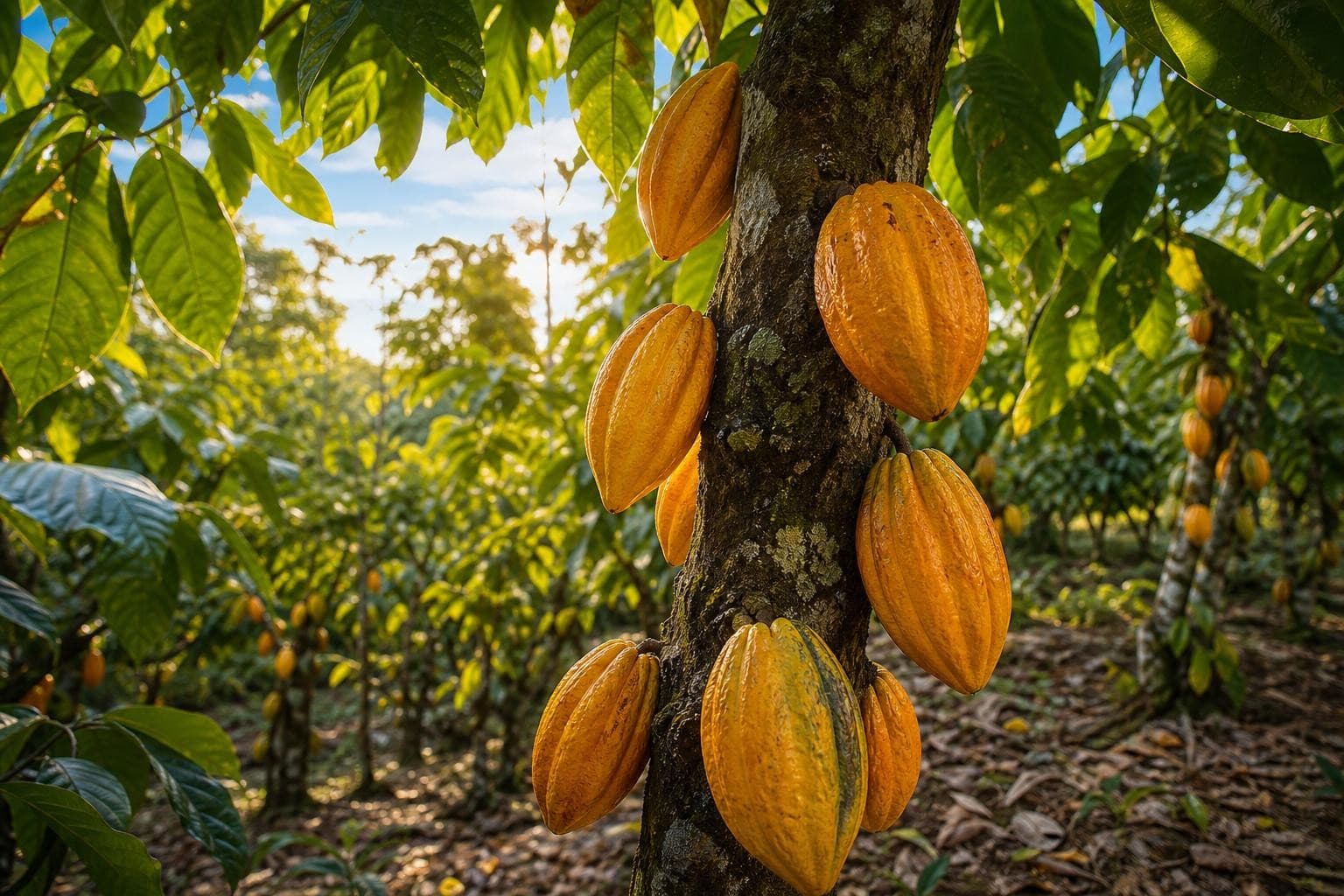
Cocoa is one of the seven EUDR commodities, so cocoa beans and products made from them, including chocolate, must be proven deforestation-free and legally produced before sale in or export from the EU. As with coffee, the hard part is collecting plot geolocation from very large numbers of smallholder farms. This page sets out what is covered and what to do.
Reviewed by the EUDR Navigator team
TL;DR
- Cocoa is in scope, covering beans, paste, butter, powder and chocolate under Annex I headings 1801 to 1806.
- Products must be deforestation-free (no clearing after 31 December 2020) and legally produced, backed by a Due Diligence Statement.
- Deadlines: 30 December 2026 for large and medium companies, 30 June 2027 for micro and small ones.
- The biggest job is geolocation across millions of smallholder cocoa farms, especially in West Africa.
In scope
What the EUDR covers for cocoa
- Cocoa beans, whole or broken, raw or roasted (CN heading 1801).
- Cocoa paste, cocoa butter, fat and oil, and cocoa powder (headings 1803 to 1805).
- Chocolate and other food preparations containing cocoa (heading 1806).
Annex I lists each product by its CN/HS customs code, so finished chocolate is covered, not just raw beans.
These products are listed in Annex I of Regulation (EU) 2023/1115 by their CN/HS customs code, so you confirm scope by matching your product code, not the product name alone.
The hard part
The hard part for cocoa
- Smallholder geolocation: cocoa is dominated by small farms, so capturing plot coordinates (and polygons for plots over 4 hectares) at scale is the central burden.
- West African supply is often aggregated by buyers and co-operatives, so lots are mixed before export and tracing back to plots is difficult.
- Chocolate makers sit several tiers downstream, so reference numbers and origin data must pass reliably along the chain.
- Blended products combine beans from many farms and countries, which complicates matching quantities to plots.
The dual test applies throughout: an in-scope product must be both deforestation-free, meaning no clearing after 31 December 2020, and legally produced. Art. 3
Origins and risk
Where it comes from and the risk tiers
Common origins for cocoa and their current EUDR risk tier. The tier decides how much due diligence applies, with low-risk origins allowing simplified due diligence. Country benchmarking (2025/1093)
- Côte d’IvoireStandard risk
- GhanaLow risk
- EcuadorStandard risk
- NigeriaStandard risk
- CameroonStandard risk
The country tier sets how much due diligence applies. Low-risk origins allow simplified due diligence; standard-risk origins need the full process. Tiers can change, as the list is reviewed in 2026.
What to do
What to do for cocoa
- Confirm scope by matching your cocoa and chocolate products against the CN/HS codes in Annex I.
- Trace your supply chain back to the farm or plot, including co-operatives and aggregators.
- Collect geolocation for every plot, plus country of production, quantities and supplier details.
- Check each origin country’s risk tier and run risk assessment and mitigation for standard and high-risk origins.
- File a Due Diligence Statement in the EU Information System and pass the reference number down the chain.
For the full obligations and the due-diligence process, see the EUDR obligations guide, and for collecting data from suppliers see the supplier data guide.
FAQ
Cocoa and the EUDR: common questions
- Is chocolate covered by the EUDR?
- Yes. Chocolate and other preparations containing cocoa fall under Annex I heading 1806, so finished chocolate is in scope, not only raw cocoa beans.
- Are cocoa butter, paste and powder in scope?
- Yes. Cocoa paste, cocoa butter, fat and oil, and cocoa powder are covered under Annex I headings 1803 to 1805. Confirm each product by its CN/HS code.
- When does the EUDR apply to cocoa and chocolate?
- Large and medium operators and traders must comply from 30 December 2026, and micro and small enterprises from 30 June 2027, where they were already established as micro or small by 31 December 2024.
- Why is cocoa geolocation so difficult?
- Cocoa is grown by millions of smallholders, often selling through co-operatives that mix lots before export. Collecting plot coordinates for every farm, with polygons for plots over 4 hectares, and keeping them linked to the right quantities is the main operational challenge.
- Do chocolate makers have to file their own DDS?
- It depends on their role. An operator who first places cocoa products on the EU market files the Due Diligence Statement. Downstream operators and traders working with inputs already covered by a statement mainly collect and pass on reference numbers.
Get ready for the EUDR
Work through the EUDR Readiness Checklist, then explore the tools and guides built for your role.
This is guidance, not legal advice
Sources
- [1]Regulation (EU) 2023/1115, consolidated text including Annex I (EUR-Lex)retrieved 4 Jun 2026
- [2]European Commission: Regulation on deforestation-free productsretrieved 4 Jun 2026
- [3]European Commission Green Forum: EUDR implementationretrieved 4 Jun 2026
- [4]First country benchmarking list under the EUDR (2025/1093)retrieved 4 Jun 2026
- [5]Council of the EU: targeted revision (second delay and simplification)retrieved 4 Jun 2026
- [6]Commission simplification review of 4 May 2026 (draft Annex I changes)retrieved 4 Jun 2026
The EUDR Brief
Subscribe to The EUDR Brief
We watch Brussels so you don't. Plain-English EUDR updates, free.
No spam. Unsubscribe anytime.